
Quick Summary
When sudden plumbing leaks, storms, or sewer backups strike, finding professional water extraction services near me is critical to halting moisture migration before rot and mold compromise the structure. Floodline Restoration Co. delivers fast emergency mitigation using advanced thermal imaging and specialized drying systems to restore subfloors and walls without relying on destructive tear-outs. Property owners can act immediately by calling the 24/7 emergency dispatch line to schedule on-site water extraction and receive a free visual inspection.
Water Extraction Services Near Me: Emergency Response and Drying Guidance
When a supply line snaps, a water heater gives out at 2:00 AM, or storm runoff fills your basement, finding reliable water extraction services near me is about stopping destruction before it spreads through framing and subfloors. Standing water migrates rapidly, soaking into structural timbers, wicking up drywall, and pooling beneath hardwood.
According to FEMA, floods caused more than $8 billion in damage to homes and businesses across the United States in 2024, including $3.8 billion in communities not classified as high risk. Furthermore, water damage and freezing were the second most common homeowners insurance claim category after wind and hail during 2018 through 2022. Fast physical extraction paired with targeted structural drying prevents permanent rot, microbial growth, and unnecessary demolition of original building materials.[1]
Rapid Response: What Happens When the Extraction Crew Arrives
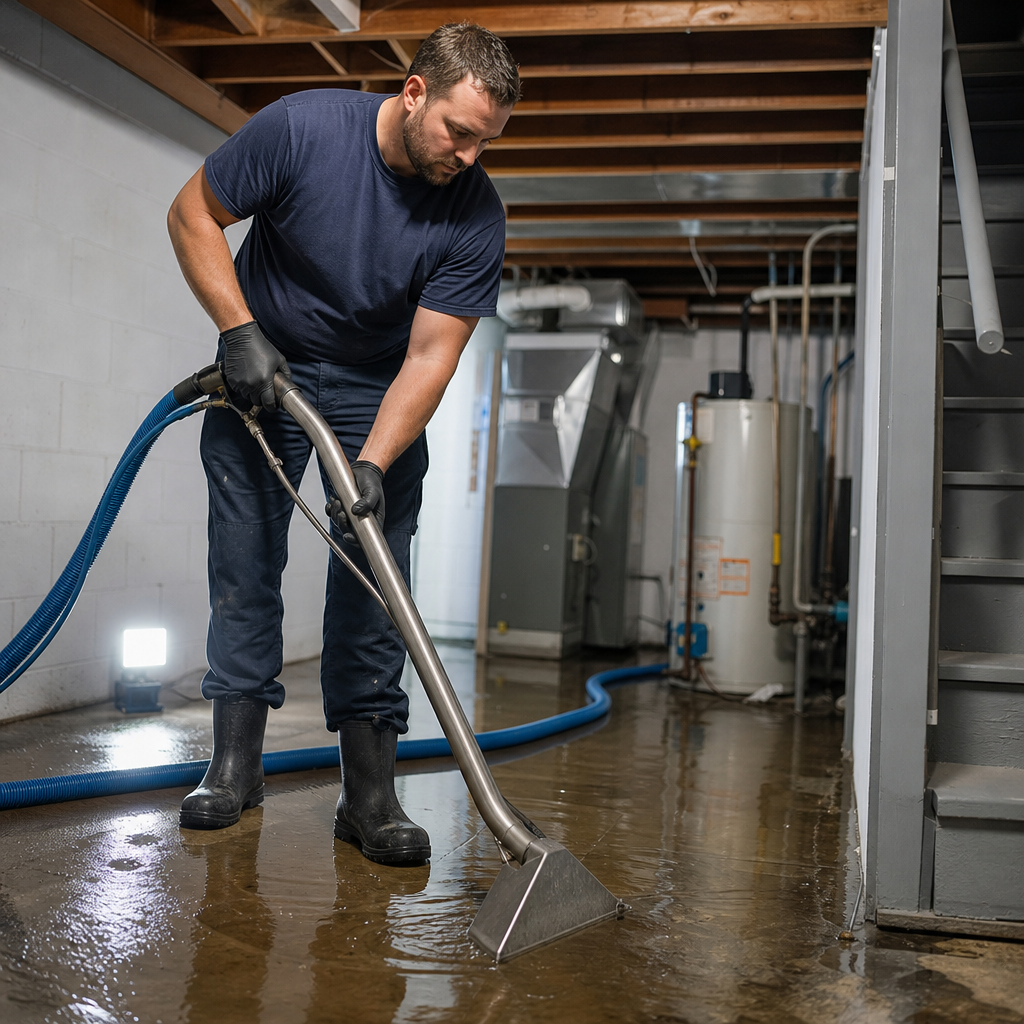
An emergency water extraction crew focuses on three immediate priorities: stopping active water migration, extracting bulk standing water, and setting up diagnostic equipment to map trapped moisture. Fast physical removal of bulk water reduces relative humidity inside the structure and limits how deep moisture penetrates into subfloors, joists, and wall cavities.
Between 2018 and 2022, water-damage claims generated an average of 1.61 claims per 100 house-years. When technicians from Floodline Restoration Co. reach a property quickly, they can stabilize structural framing before water permanently degrades sensitive architectural assemblies.[3]
Immediate Actions to Take While Dispatch Is En Route
Taking focused containment steps helps protect your property while the emergency response team is on the road:
- Shut off the main water valve: Turn the primary gate or ball valve clockwise to stop incoming water flow instantly.
- Isolate electrical power safely: Switch off the circuit breakers for the flooded rooms only if the electrical panel is in a completely dry, safe area. Never walk through standing water to reach a breaker box.
- Protect porous furniture and textiles: Lift draperies off wet flooring, slip aluminum foil or plastic risers under furniture legs, and move area rugs to a dry area to prevent dye transfer onto underlying floors.
The Initial On-Site Moisture Assessment
Once on-site, technicians do not just look at surface water; they inspect structural pathways. Using non-invasive moisture meters, penetrating pin probes, and thermal imaging cameras, the crew tracks the perimeter of moisture migration behind baseboards, beneath tiles, and inside wall cavities. This mapping creates a baseline to track daily progress and ensures no pockets of moisture remain hidden.
The Hidden Danger of Premature Demolition: Targeted Drying vs. Tear-Out
A major frustration property owners face during an emergency is the aggressive “rip-and-replace” approach pushed by some mitigation companies. Contractors often rush into older properties, such as pre-war homes with plaster-on-lath walls and old-growth hardwood floors, and immediately begin tearing down walls and ripping out flooring. This approach causes unnecessary damage, inflates repair costs, and creates disputes with insurance adjusters.
Targeted cavity drying and specialized hardwood floor mat systems offer a practical alternative. By using high-pressure negative air systems, dehumidifiers, and directed heat injectors, technicians from Floodline Restoration Co. can draw bound moisture directly out of dense oak subfloors and plaster walls without gutting the room. Preserving original structural elements protects historic architecture and provides clear data for claim evaluation.
Flood Damage and Standing Water Extraction
Storm surges, overland flooding, and foundation seepage introduce ground-level runoff that demands strict mitigation standards. Unlike clean domestic supply leaks, storm water carries silt, organic debris, and exterior contaminants directly into basements and crawlspaces.
Handling Storm and Ground-Level Ingress
Heavy rainfall along low-lying corridors and drainage basins can overwhelm residential sump pumps in minutes. High-volume extraction units and submersible trash pumps are deployed to pull standing water out of the building rapidly, relieving hydrostatic pressure on foundation walls.
Category 2 and Category 3 Water Decontamination
Water damage falls into distinct categories based on contamination levels. Floodwaters and sewer backups require specific handling protocols:
- High-Volume Industrial Extraction: Submersible pumps clear bulk water, mud, and sediment from lower structural levels.
- Antimicrobial Sanitization: EPA-registered botanical or commercial-grade antimicrobials are applied to exposed concrete, masonry, and framing to neutralize bacteria.
- Controlled Evaporation: Dehumidifiers lower ambient vapor pressure to pull remaining moisture from structural framing without spreading airborne contaminants.
Preventing Mold Growth and Microbial Spread
Need water extraction services near me?
We’re available now - call for a fast, free estimate.
According to expert guidance from Floodline Restoration Co., mold spores may begin appearing within three to seven days of water exposure, making rapid drying strongly recommended. When searching for water extraction services near me, choosing a team that understands microbial control ensures your living spaces remain safe and structurally sound.
Between 2018 and 2022, the average homeowners insurance payout for water damage and freezing claims was $13,954. A large portion of escalated costs stems from delayed drying that allows mold colonies to take root inside wall cavities and subflooring.[4]
HEPA Filtration and Containment Protocols
To prevent spores from circulating into unaffected living areas or commercial workspaces, technicians establish isolated drying chambers using heavy-duty poly sheeting. Commercial air scrubbers equipped with HEPA filtration operate continuously, capturing airborne particulates while structural drying is underway.
Sewage Cleanup and Biohazard Containment
A sewer line backup is a Category 3 blackwater emergency. It brings dangerous biological pathogens, bacteria, and viruses directly into finished living spaces or utility areas, demanding immediate biohazard containment.
Technicians wear personal protective equipment (PPE) and use sealed vacuum containment systems to extract wastewater safely. Porous materials that directly absorb blackwater, such as carpet padding and low-density insulation, are safely bagged and disposed of according to applicable regulations. Structural framing, concrete slabs, and salvageable subfloors are sanitized, flushed, and tested before structural drying begins.
Fire Suppression Water Removal
Putting out a structure fire often leaves behind thousands of gallons of water alongside soot and smoke residue. This firefighting water accumulates in basements, pools under subfloors, and saturates wall insulation. If left standing, it mixes with acidic soot, accelerating corrosion on metal framing and deeply staining masonry.
Emergency extraction crews pump out standing suppression water immediately. Technicians then pair air scrubbers with dehumidification equipment to eliminate humidity, dry out saturated framing, and neutralize persistent smoke odors simultaneously.
Burst Pipes and Plumbing Supply Failures
Plumbing failures create some of the most sudden and widespread water losses. A frozen pipe split behind an upstairs bathroom or a ruptured refrigerator supply line can run undetected for hours, cascading through ceilings, running down interior wall cavities, and soaking multiple levels of a property.
Technicians at Floodline Restoration Co. use thermal imaging to track water paths inside vertical chases and floor systems. Rather than tearing down full ceiling spans, restoration crews can drill inspection holes at the base of wall plates and use directed injection systems to force dry air straight into the framing cavities.
Structural Drying: Equipment and Preservation Methods
Need water extraction services near me?
We’re available now - call for a fast, free estimate.
Pumping out visible standing water is only the first stage of the job. Structural drying draws out deeply absorbed moisture to return building materials to normal moisture levels.
| Equipment Type | Primary Function | Application |
|---|---|---|
| Truck-Mounted Extraction Units | Rapid removal of high-volume standing water | Basements, commercial slabs, saturated carpeting |
| Dehumidifiers | Pulls moisture vapor out of the air | Whole-room environmental stabilization |
| Centrifugal Air Movers | Creates laminar airflow across wet surfaces to accelerate evaporation | Subfloors, joists, and exposed framing |
| Hardwood Floor Mat Systems | Applies negative pressure to pull moisture through dense wood | Preserving solid oak, maple, and historic plank flooring |
| Cavity Injection Dryers | Forces warm, dry air into enclosed stud spaces | Drying plaster and drywall without large-scale tear-out |
Material Considerations: Drywall, Plaster, and Hardwood
Different materials require different drying methods. Understanding these distinctions prevents unnecessary property loss:
- Plaster-on-Lath Walls: Traditional plaster handles water exposure far better than modern drywall. If the keys (the plaster hooks holding the wall to the wood lath) remain structurally intact, plaster can often be saved using continuous dehumidification and cavity airflow.
- Drywall and Gypsum Board: When drywall remains submerged, the gypsum core softens and loses structural integrity. According to expert guidance, clean water events may allow drywall to be dried in place if addressed quickly, whereas contaminated water events typically require removing affected drywall above the water level to inspect framing and insulation.
- Hardwood and Subflooring: Solid hardwood planks warp and cup as the bottom of the wood absorbs moisture faster than the top surface. Specialized floor drying mats draw trapped moisture upward through the grain, flattening the boards and avoiding costly floor replacement.
Cost Factors and Insurance Navigation
The cost of professional water extraction depends on the affected area, the category of contamination, how long the water has been standing, and specific drying requirements. No reliable neutral average for water extraction alone is available in the research due to these wide variations in scope.
Insurance coverage depends on the specific policy, the cause of loss, applicable exclusions, deductibles, and whether flooding is involved. Standard policies often cover sudden and accidental water damage but exclude regional flooding, which requires dedicated flood coverage. Property owners should report losses promptly and confirm coverage terms directly with their insurer rather than assuming approval is guaranteed.[2]
Frequently Asked Questions
How quickly can an emergency water extraction team arrive?
Response times vary depending on geographic location, time of day, weather conditions, local demand, and the extent of the emergency. Contact your local provider directly to confirm estimated arrival times.
How much does professional water extraction cost on average?
Costs vary based on the size of the affected area, the degree of contamination, and necessary drying requirements. There is no reliable neutral average available for water extraction alone because project scopes differ significantly.
Does homeowners insurance cover emergency water extraction services?
Coverage depends on the specific policy terms, the underlying cause of loss, policy exclusions, deductibles, and whether floodwaters are involved. Promptly report the damage and confirm details directly with your insurance provider.
What is the difference between water extraction and full water damage restoration?
Water extraction is the physical removal of standing, pooled liquid using pumps and vacuum tools. Full restoration includes diagnostic moisture mapping, structural dehumidification, antimicrobial sanitization, and the physical repair or reconstruction of damaged walls, subfloors, and finishes.
What equipment is used to remove standing water and dry structural elements?
Restoration crews like Floodline Restoration Co. rely on vacuum extractors, submersible pumps, air movers, dehumidifiers, floor mat extraction systems, and thermal imaging cameras to track and remove moisture.
How long does the water extraction and drying process take?
Physical water extraction can often be completed quickly, but overall drying times vary depending on the extent of saturation, material density, ambient humidity, and environmental conditions.
Need water extraction services near me?
We’re available now - call for a fast, free estimate.
Sources
- The Cost of Flooding – floodsmart.gov (2024)
- 2024: An active year of U.S. billion-dollar weather and climate … – climate.gov (2024)
- Restoration Cost Statistics (2026) – rapideyeinspections.com (2026)
- GEO for water damage restoration in 2026 | Subscribe PR – subscribepr.com (2026)
Frequently Asked Questions
Can emergency water extraction save cupped hardwood floors without replacing them?
Yes, specialized hardwood floor mat systems apply negative pressure to pull trapped moisture upward through the grain of the wood. Floodline Restoration Co. deploys these non-invasive extraction tools to flatten cupped boards and preserve original hardwood flooring without expensive tear-outs.
How does thermal mapping prevent unnecessary drywall and plaster demolition?
Thermal imaging cameras detect hidden temperature differences caused by evaporative cooling, pinpointing moisture migration behind walls and under subfloors without cutting exploratory holes. Technicians from Floodline Restoration Co. use these thermal maps to guide targeted cavity dryers directly into wet framing bays, leaving intact drywall and plaster undisturbed.
Why is a 45-minute water extraction response critical for preventing secondary damage?
Standing water rapidly wicks into framing and creates prime conditions for mold spores to colonize within three to seven days. A rapid 45-minute dispatch by Floodline Restoration Co. halts moisture migration before water degrades subflooring, warps structural timbers, or escalates insurance claim costs.
About the author
 |
Marcus Caldwell Marcus Caldwell is an IICRC-certified Water Damage Restoration Technician with over 12 years of hands-on experience in emergency property recovery across New Jersey. Holding a B.S. in Construction Management from Rutgers University, he specializes in structural drying techniques and navigating complex insurance claims for both residential and commercial properties. Marcus leverages his field expertise to provide Englewood property owners with clear, actionable guidance on mitigating water damage and understanding restoration costs. |
Water damage, flood, or mold emergency?
We’re available now - call for a fast, free estimate.
Call Now - Free Estimate