
Quick Summary
Rapid emergency flood cleanup in Englewood, NJ is essential to protect residential and commercial properties from severe structural rot, electrical hazards, and fast-spreading mold colonization. Floodline Restoration Co. delivers 24/7 rapid-response mitigation with a 45-minute on-site arrival, using advanced thermal imaging and specialized restorative drying techniques engineered to preserve historic pre-war balloon framing and hardwood assemblies without unnecessary demolition. Readers will understand the multi-step structural drying process, learn how detailed documentation streamlines carrier insurance claims, and discover how to secure immediate local flood extraction services.
Emergency Flood Cleanup in Englewood, NJ: Fast-Response Water Removal & Structural Drying
When clean water supply lines burst, groundwater breaches a foundation, or storm runoff rushes into a basement, waiting hours for help turns a manageable cleanup into a full-scale structural rebuild. Emergency flood cleanup services in Englewood, NJ provide dispatching of certified local crews equipped for immediate water extraction, deep structural drying, and property stabilization.[5]
New Jersey state mitigation materials classify Bergen County as having flood hazard risks. In older or historic homes that may feature plaster walls or continuous balloon framing, standard generic restoration tactics can cause structural issues. Certified technicians use targeted thermal diagnostics and preservation-focused drying methods to extract standing water, protect building materials, and mitigate mold risks.[1]
From initial emergency extraction to documenting damage for insurance carriers, professional teams like Floodline Restoration Co. manage the recovery process to stabilize affected properties.
24/7 Emergency Flood Cleanup in Englewood, NJ
Getting water out of a building quickly is only the first step. True emergency mitigation requires stabilizing the indoor environment, containing electrical and biological hazards, and pulling deep moisture out of structural framing before secondary rot sets in. Cleanup teams operate on continuous standby to protect residential and commercial properties throughout Englewood and surrounding Bergen County neighborhoods.[2]
Immediate Response Across Bergen County
Water moves fast through residential structures. According to historical flood data tracked by the U.S. Geological Survey (USGS), northern New Jersey waterways and local drainage basins experience surge events during major storms. When municipal drainage backs up or sump pumps fail under heavy load, delays directly translate to ruined subfloors and warped structural members. Local technicians at Floodline Restoration Co. mobilize commercial-grade truck-mounted extractors to respond to water emergencies.
Step-by-Step Emergency Stabilization
When crews arrive, they take control of the environment to prevent escalating damage:
- Site Safety and Hazard Control: Crews verify electrical safety, check for structural sagging, and identify the water source (clean supply water, gray appliance runoff, or Category 3 black water and sewage).
- Thermal Moisture Mapping: Using high-resolution infrared cameras and non-penetrating moisture meters, technicians map the full boundary of moisture travel behind walls and beneath flooring without invasive demolition.
- Bulk Water Extraction: High-powered submersible pumps and weighted extraction units remove standing water, relieving hydrostatic pressure on foundation slabs and floor joists.
- Environmental Containment: HEPA air scrubbers and containment barriers isolate affected areas, maintaining indoor air quality throughout the rest of the building.
Flooded Basements and Pre-War Framing: Protecting Historic Englewood Properties
Need emergency flood cleanup englewood nj?
We’re available now - call for a fast, free estimate.
Older homes in the area may feature historic building methods, such as plaster-on-lath walls, older subflooring, and continuous balloon framing.
The Hidden Risk of Balloon Framing and Plaster Walls
In standard modern construction (platform framing), each floor level has a wooden sole plate that acts as a natural fire and moisture stop between stories. In balloon framing, exterior wall studs run continuously from the foundation sill up toward upper levels. When water floods a basement, these open vertical stud bays can pull damp, humid air upward into upper-story wall cavities.
Standard flood cuts into historic plaster walls can compromise the lath and release moisture into vertical chases. Rather than gutting plaster-on-lath, technicians from Floodline Restoration Co. can apply directional airflow and cavity-injection drying systems to force warm, dehumidified air directly through wall bays, drying the framing in place.
Managing Runoff and Groundwater Concerns
Properties situated near local waterways or slopes can face hydrostatic pressure during sustained rainfall. Englewood appears in FEMA flood program records. When groundwater pushes through fieldstone or poured-concrete foundations, water extraction must be paired with low-grain refrigerant (LGR) or desiccant dehumidification to stabilize the basement microclimate before foundation settling or fungal growth occurs.[3]
Salvaging Hardwood Floors, Subfloors, and Building Assemblies
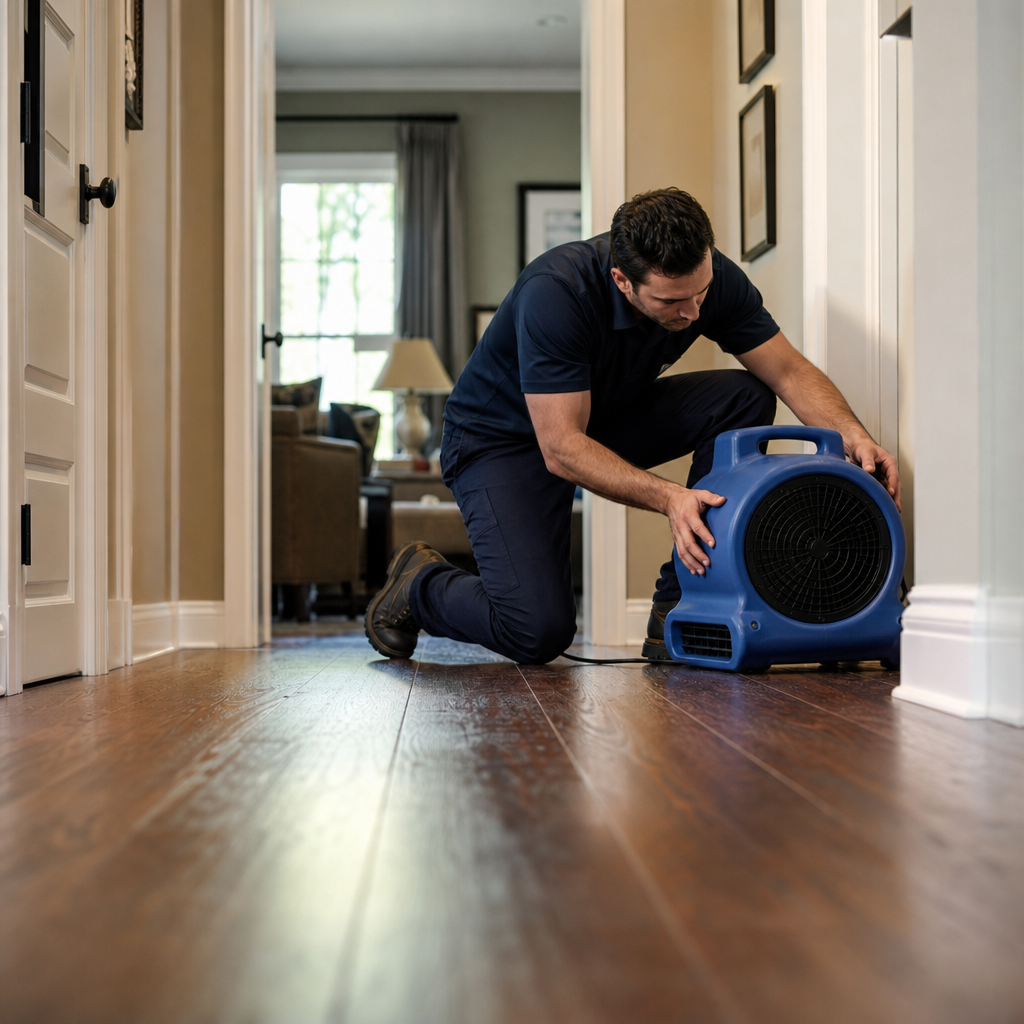
Water-damaged hardwood flooring does not always need to be torn out and discarded. If mitigation starts early, dense wood and subfloors can frequently be saved using non-destructive drying technologies.
Precision Mat-Drying and Cavity Systems
When water sits on hardwood floors, moisture enters the porous cell structure from the underside, causing planks to expand, cup, and crown. Traditional fans simply dry the surface, locking moisture beneath the finish. Specialized negative-pressure floor mat systems installed over the wood create an airtight seal, drawing trapped moisture out from the underside of the floorboards and subfloor. Combined with desiccant dehumidifiers, this process helps reverse cupping and return flooring to safe moisture levels.
Preventing Mold Growth and Microbial Spread
Fungi require organic material, ambient warmth, and elevated moisture levels to colonize. In humid summer conditions, mold spores can germinate within 24 to 48 hours after water intrusion. To prevent this, technicians carry out a multi-step preservation protocol:
- Psychrometric Monitoring: Tracking temperature, relative humidity, and grains per pound (GPP) daily to maintain an effective drying environment.
- Botanical Antimicrobial Application: Treating exposed framing, masonry, and foundation sills with EPA-registered antimicrobial solutions to halt fungal development.
- Controlled Structural Desiccation: Running drying equipment continuously until deep structural materials read at acceptable baseline moisture levels.
Choosing a Restoration Partner: Restorative Drying vs. Demolition-First Contractors
Need emergency flood cleanup englewood nj?
We’re available now - call for a fast, free estimate.
The approach chosen during an emergency determines whether materials are dried and preserved or gutted down to the studs:
| Service Feature | Restorative Drying Services | National Franchise Chains | General Remodelers |
|---|---|---|---|
| Emergency Response | Direct local dispatch | Call routing centers | Standard business hours |
| Historic Home Expertise | Targeted drying for balloon framing & plaster | Standard drywall flood cuts and gutting | Full demolition and rebuild approach |
| Drying Technology | Floor-mat suction panels & cavity injection | Standard air movers and basic dehumidifiers | Passive open-air drying / box fans |
| Insurance Management | Daily moisture logs & carrier documentation | Basic loss documentation | Manual homeowner claim management |
| Workflow Continuity | Coordinated mitigation and structural recovery | Mitigation only (subcontracts build-back) | Rebuild only (requires separate mitigation) |
Restoration Methodology
Treating an older structure like a modern drywall build can lead to unnecessary repair costs and loss of architectural features. Preservation-focused technicians dry building assemblies in place, protecting original trim, baseboards, and framing while managing the project timeline.
Insurance Documentation
Navigating insurance claims during water damage requires clear documentation. Project managers at Floodline Restoration Co. document project phases using line-item estimates, thermal photos, and daily moisture logs. Providing objective proof of drying standards helps carriers review data required for claim processing.[4]
What Does Emergency Flood Cleanup in Englewood, NJ Cost?
Total costs depend on several measurable factors determined during an initial on-site assessment:
- Water Contamination Level: Category 1 (clean supply line breaks) requires standard extraction and drying. Category 2 (appliance discharge) and Category 3 (sewage backups or outdoor storm runoff) require containment, sanitization, and specialized disposal protocols.
- Scope of Affected Area: The total square footage, number of vertical levels affected, and whether moisture has traveled into wall cavities determine the amount of equipment needed.
- Material Density: Dense plaster, multi-layered subfloors, and solid wood require longer drying cycles than standard modern drywall and plywood.
- Equipment Deployment Duration: Structural drying projects typically require commercial dehumidifiers and air movers to run for several days to reach baseline moisture levels.
Insurance Coverage and Out-of-Pocket Costs
Insurance coverage depends on the specific policy, the cause of the water loss, and applicable deductibles. Homeowners policies often cover certain sudden and accidental internal water damage events, while damage resulting from rising groundwater or external floodwaters generally requires separate flood insurance coverage. Property owners should review their policy terms with their insurance carrier or adjuster to confirm coverage details for extraction, drying, and structural repairs.
Frequently Asked Questions About Englewood Flood Recovery
How quickly can an emergency flood cleanup team arrive at an Englewood, NJ property?
Response times vary by conditions and availability. Dispatch teams work to mobilize local technicians as quickly as possible to assess damage and begin water extraction.
What immediate steps should I take while waiting for the cleanup technicians?
If safe to do so, shut off the main water supply valve to stop incoming water. Turn off electrical circuit breakers for flooded areas, avoiding walking through standing water to access breaker panels. Avoid running household vacuum cleaners, as they present electrical shock hazards in wet environments. Move light, high-value personal items off wet flooring to prevent secondary damage.
Does homeowners insurance cover emergency flood cleanup and water extraction?
Coverage depends on policy terms and the source of water. Homeowners insurance may cover sudden, accidental internal plumbing failures, whereas overland flooding or surface runoff typically requires a dedicated flood insurance policy. Technicians from Floodline Restoration Co. can assist by providing moisture documentation and logs directly to carriers.
How long does the flooded basement drying and restoration process take?
Bulk water extraction is usually completed within hours of arrival. The structural drying phase typically takes between 3 and 5 days, depending on whether materials involve modern drywall or denser historic plaster and subflooring. Technicians monitor moisture readings daily until verified baseline levels are reached.
How do flood restoration experts prevent mold growth after water damage?
Mold growth is mitigated by rapidly extracting moisture before spores can germinate. This is achieved by combining water extraction, commercial dehumidification, targeted air movement, and the application of EPA-registered antimicrobial treatments on exposed structural framing.
Need emergency flood cleanup englewood nj?
We’re available now - call for a fast, free estimate.
Sources
- [PDF] FEMA Hazard – NJ.gov – nj.gov (2024)
- 1. – dep.nj.gov (2020)
- Community status book report for state NJ – fema.gov
- Microsoft Word – 10.25.08 BC Natural Hazard Mit Plan For Towns.doc – meri.njmeadowlands.gov
- [PDF] Community Status Book Report Federal Emergency Management … – nj.gov
Frequently Asked Questions
Can water-damaged hardwood floors be saved without tearing them out?
Yes, if emergency mitigation begins promptly, Floodline Restoration Co. utilizes negative-pressure floor mat drying systems paired with commercial desiccant dehumidifiers to draw trapped moisture out from underneath the planks and subfloor. This non-invasive extraction process reverses wood cupping and restores flooring to standard moisture baselines without expensive tear-outs.
How does Floodline Restoration Co. dry balloon-framed walls without demolishing historic plaster?
Rather than performing invasive flood cuts that destroy historic plaster-on-lath walls, technicians use precision cavity-injection drying equipment to deliver warm, dehumidified airflow directly into the vertical stud bays. This targeted approach dries the continuous framing from within, halting structural rot and mold development while preserving original architectural assemblies.
Does Floodline Restoration Co. handle full structural reconstruction after the water extraction phase?
Yes, Floodline Restoration Co. provides complete mitigation-to-rebuild continuity, managing everything from 45-minute rapid water extraction and antimicrobial sanitization to structural carpentry, drywall replacement, and finish repairs. Handling both mitigation and reconstruction under a single local team simplifies insurance claim processing and accelerates total property recovery.
About the author
 |
Sarah O’Connor Sarah is a certified restoration professional with over 8 years of experience in property damage mitigation and recovery. She holds an IICRC certification in Water Damage Restoration and Applied Microbial Remediation, allowing her to provide expert guidance on safe and effective cleanup strategies. Her writing focuses on actionable advice to help homeowners and property managers navigate the stress of sudden property disasters and the complexities of insurance claims. |
Water damage, flood, or mold emergency?
We’re available now - call for a fast, free estimate.
Call Now - Free Estimate